Uzbekistan
Asia11 photographs
The Silk Road's greatest hits — the Registan, Bukhara's blue domes, and Tashkent's Soviet grandeur.
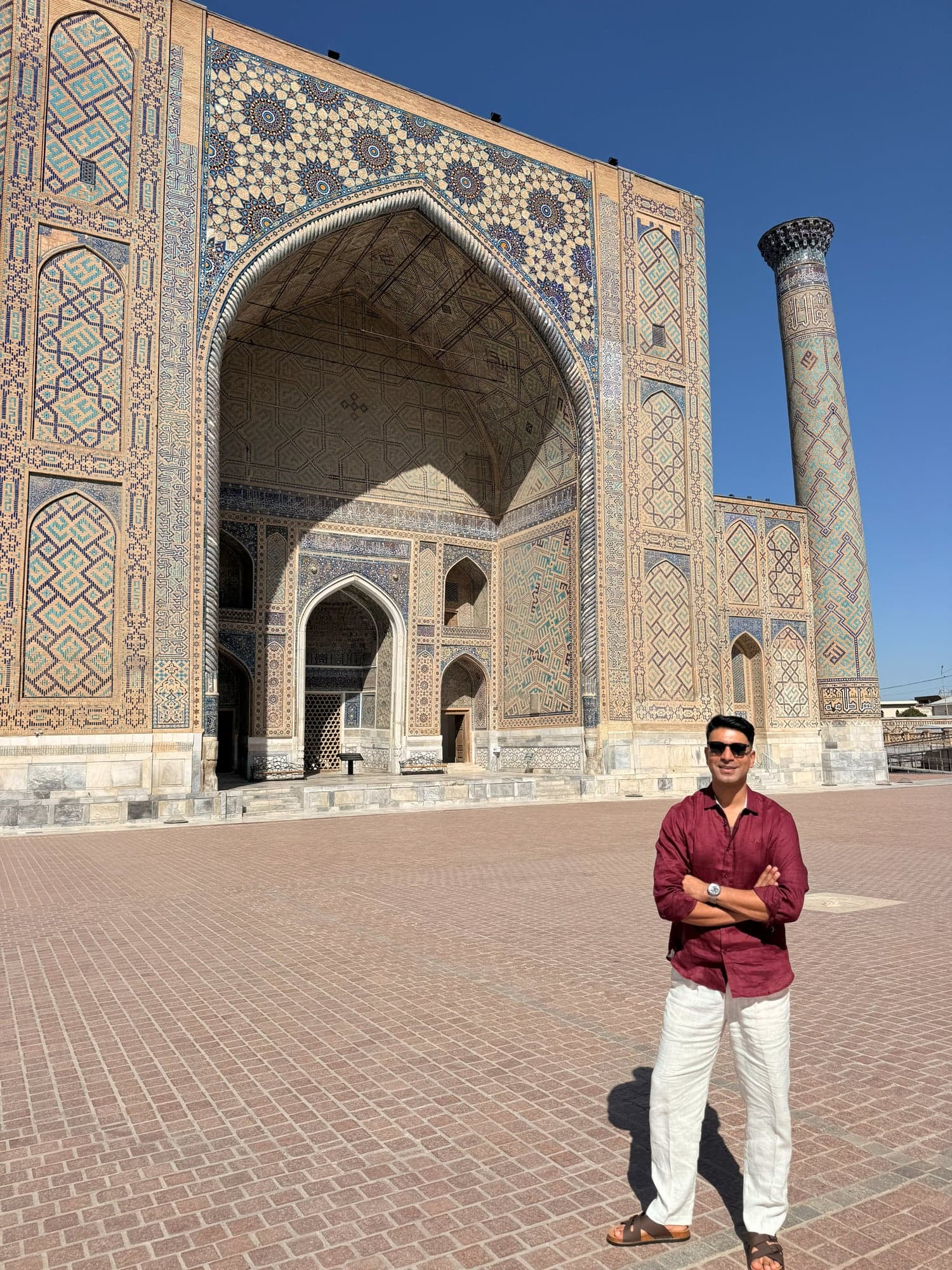
If there's one country this whole Central Asia run was building toward, it was Uzbekistan. Samarkand does exactly what four hundred years of postcards promised: the Registan Ensemble at sunset, three madrasas facing each other across a single square, every surface — the Tilya-Kori's tiled iwan, the twisting minaret beside it — covered in geometric tilework so dense it stops registering as decoration and starts feeling structural. Shah-i-Zinda, the avenue of tombs climbing a hillside nearby, might be even better: a corridor of turquoise-and-cobalt domed mausolea stacked one after another, quieter than the Registan and somehow more overwhelming for it. From a terrace above Bibi-Khanym Mosque at dusk, the whole ensemble sat gold against a darkening sky, worth the wait for the light alone.
Bukhara felt older and slower — trading domes at Toki Sarrafon still function as a bazaar the way they have for centuries, souvenir stalls selling engraved knives and brass samovars under the same brick cupolas where silk and spice once changed hands. The Mir-i-Arab Madrasah lit up blue after dark, its twin domes glowing above the old town, and dinner at a plov house that's apparently a Bukhara institution did nothing to talk me out of ordering a second plate.
Tashkent, by contrast, is unapologetically Soviet — Hotel Uzbekistan's honeycomb concrete facade still dominates its stretch of skyline, and Amir Temur Square puts the founder of the Timurid Empire on a rearing bronze horse right in front of it, past and present refusing to pick a side.